
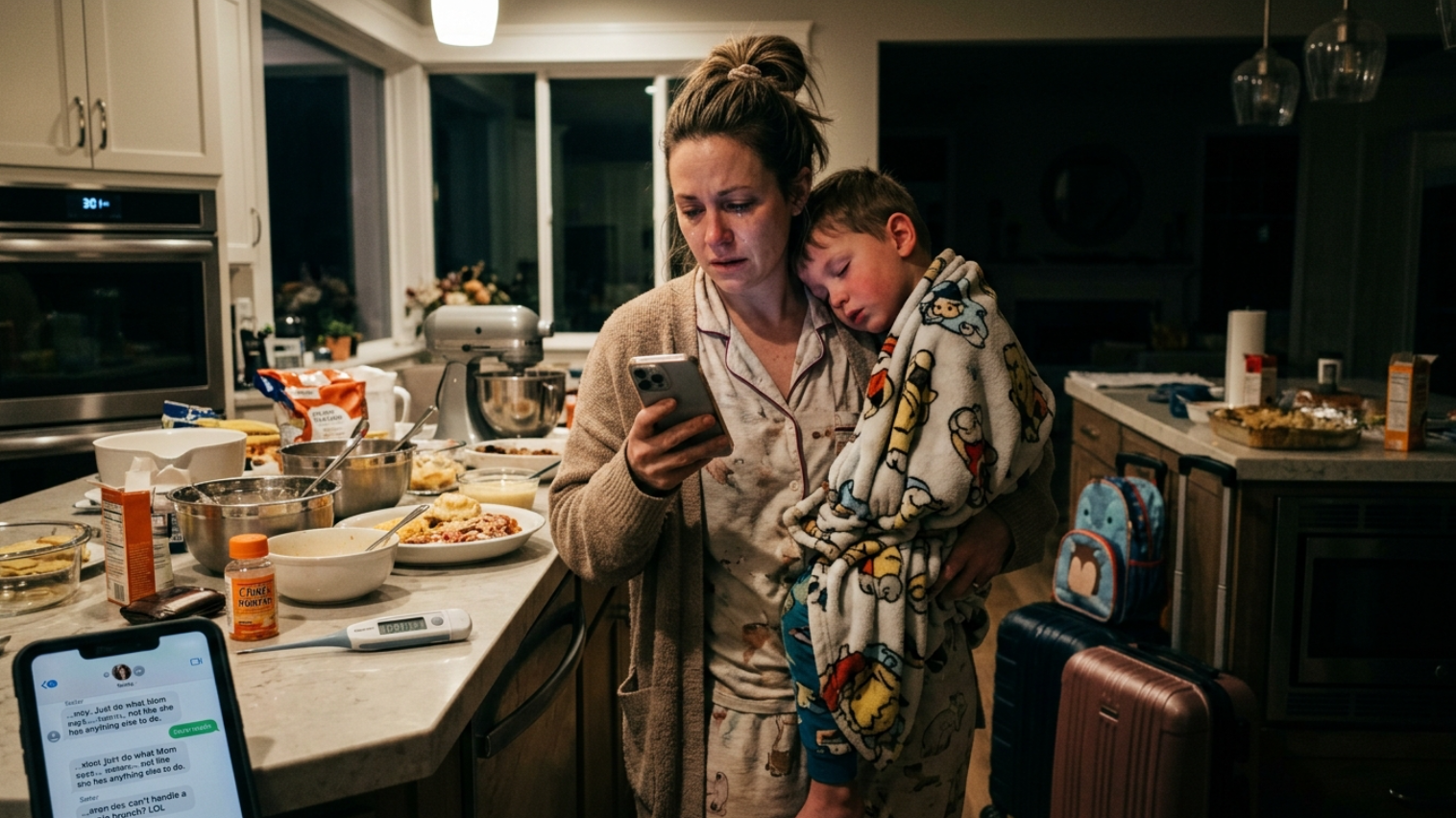
I hesitated.
“Not today.”
“Is he mad?”
I swallowed.
“No, sweetheart.”
That was a lie.
I didn’t know if Neil was mad.
I knew I was.
But I wasn’t going to put that weight on a six-year-old.
Maren met us in her driveway at 9:14.
The moment she saw Wyatt, she stopped smiling.
“Oh, honey.”
She opened the passenger door.
“Come inside.”
I carried Wyatt in while Maren took the bags.
She didn’t ask about the brunch.
She didn’t ask about Neil.
She didn’t ask why I had two suitcases.
She simply made a bed on the couch, brought water, found children’s blankets, and turned the television down when Wyatt complained that the noise hurt his head.
That was my sister.
She didn’t need an explanation before offering help.
At 9:47, my phone started ringing.
Neil.
I watched it vibrate across the coffee table.
Once.
Twice.
Three times.
Maren looked at me.
“You don’t have to answer.”
“I know.”
The fourth call came.
I answered.
“Where are you?”
His voice sounded irritated.
“With Wyatt.”
“I know you’re with Wyatt. Where?”
“Maren’s.”
“You took him out of the house without telling me.”
I looked at the clock.
“You knew I was leaving.”
“I thought you’d go for a few hours.”
“You watched me pack two suitcases.”
“I didn’t realize you were actually leaving.”
I almost laughed.
“You didn’t realize?”
“Tara, Mom is already here.”
I closed my eyes.
Of course.
That was what mattered.
“Then you have your brunch.”
“Don’t do this.”
“Do what?”
“Punish me.”
“I took our sick son to urgent care.”
“You took him to Maren’s without telling me where you’d be.”
“I just told you.”
“After the fact.”
I looked at Wyatt.
He was asleep.
Finally.
“Neil, he has strep.”
Silence.
“What?”
“The test was positive.”
“Oh.”
One word.
Oh.
No apology.
No concern.
No question about his fever.
Just:
“Oh.”
I said, “He needs antibiotics and rest.”
“Is he okay?”
“Yes.”
“Then bring him home.”
I stared at the wall.
“Why?”
“Because he’s my son.”
“And he’s mine.”
“I didn’t say he wasn’t.”
“You said bring him home.”
“Because this is his house.”
I lowered my voice.
“No, Neil. Right now, his home is wherever he can rest without twelve people eating brunch downstairs.”
“That’s not fair.”
“No.”
I paused.
“What’s not fair is that you knew he was sick and still prioritized your mother’s plans.”
“Mom didn’t make me do anything.”
I said nothing.
He knew.
I knew.
Then his voice hardened.
“Are you seriously trying to use Wyatt against me?”
My stomach dropped.
Because those were Linda’s words.
Not his.
Or maybe they were his now.
“I am not using Wyatt against you.”
“You’ve always threatened to leave whenever we fight.”
I sat down.
“Always?”
“Yes.”
“Name one time.”
Silence.
“Exactly.”
He exhaled.
“Come home.”
“No.”
“Tara.”
“No.”
“I have guests.”
“I know.”
“You’re embarrassing me.”
There it was.
Not Wyatt.
Not concern.
Embarrassment.
I looked at Maren.
She was standing in the kitchen, pretending not to listen.
I said quietly, “I didn’t embarrass you.”
“What?”
“Your choices did.”
I hung up.
My hands were trembling.
Maren walked over.
“What happened?”
I handed her my phone.
She read the messages.
Then the screenshots.
Her face changed.
“Where did you get these?”
“Chloe.”
Maren read everything.
When she finished, she put the phone down.
“Tara.”
“I know.”
“No.”
She sat beside me.
“You don’t know.”
“What?”
“You’re still thinking this is a fight about Linda.”
I stared at her.
“It isn’t.”
“It’s about Neil.”
That sentence landed harder than anything else.
Maren continued.
“His mother can’t control your marriage unless he gives her access to it.”
I looked toward Wyatt.
“What am I supposed to do?”
“Don’t go home today.”
“I wasn’t planning to.”
“And don’t threaten him.”
“I won’t.”
“Don’t send angry messages.”
“I won’t.”
“Don’t post anything.”
“I wasn’t going to.”
“Don’t tell the family you’re getting divorced.”
I looked at her.
“I’m not.”
“Good.”
She took my hand.
“Then stop acting like you have to decide your entire future today.”
I felt tears building.
“I just don’t know what to do.”
“Yes, you do.”
“What?”
“Protect your son. Protect yourself. Get information. Then decide.”
That afternoon, I called the attorney Chloe had recommended.
Her name was Rachel Morgan.
She didn’t tell me to divorce Neil.
She didn’t tell me to stay.
She asked questions.
When did Linda begin staying overnight?
Who owned the house?
Whose name was on the mortgage?
Who handled school pickups?
Who attended doctor’s appointments?
Who paid for childcare?
Who had access to medical records?
Had Neil ever threatened me?
Had I ever threatened to take Wyatt away?
Had there been police calls?
Had there been documented violence?
Had I ever been hospitalized for mental health reasons?
No.
No.
No.
No.
No.
The questions weren’t accusations.
They were preparation.
Rachel explained that family-court disputes were rarely decided by whoever had the most dramatic story.
They were based on evidence, stability, caregiving history, and the child’s best interests.
“Do not manufacture anything,” she said.
“I won’t.”
“Don’t provoke him.”
“I won’t.”
“And don’t disappear with your son.”
“I already left.”
“You went to your sister’s because your child was sick. That’s different from concealing a child.”
I wrote everything down.
Then she said something that stayed with me.
“If you are worried that your husband and his mother are constructing a narrative about you, your job isn’t to destroy their narrative. Your job is to live in a way that makes the truth easy to prove.”
That evening, I created a folder.
Medical records.
School records.
Daycare receipts.
Doctor appointments.
Messages.
Bank statements.
Mortgage documents.
Not because I was planning war.
Because I had finally stopped assuming peace would protect me.
At 7:18, Neil sent me a message.
Mom says you need to come home before this gets worse.
I stared at it.
Then another.
The family is worried about you.
Then:
Everyone thinks you’re overreacting.
I didn’t respond.
A minute later:
Are you seriously refusing to communicate?
Still nothing.
Then:
You can’t just take Wyatt and disappear.
I finally typed one sentence.
Wyatt is with me. He is safe and receiving his prescribed treatment. I am not discussing our marriage while he is sick.
I sent it.
Then put my phone away.
Maren looked at me.
“That’s all?”
“That’s all.”
She smiled slightly.
“Good.”
At 9:03, Chloe called.
Her voice was shaking.
“Tara?”
“What’s wrong?”
“There’s something else.”
My stomach tightened.
“What?”
“Mom’s still at your house.”
“I assumed she left.”
“She hasn’t.”
“Why?”
“I don’t know.”
“What happened?”
Chloe hesitated.
“She told everyone you were having some kind of breakdown.”
I closed my eyes.
“What?”
“She said you’d been acting unstable for weeks.”
I almost laughed.
“I’ve been working full-time, taking Wyatt to school, handling his appointments, paying bills, and organizing her brunch.”
“I know.”
“What did Neil say?”
“He didn’t defend you.”
Silence.
Then Chloe said:
“He didn’t exactly agree either.”
“What does that mean?”
“He just kept saying everyone needed to stay calm.”
I knew what that meant.
He was letting the accusation breathe.
And sometimes silence was more powerful than agreement.
Chloe continued.
“Tara, I heard Mom telling Aunt Cheryl that if you didn’t come back tonight, she would call Neil’s attorney.”
I sat upright.
“His attorney?”
“I don’t know if he actually has one.”
“Did Neil say anything?”
“No.”
“Chloe.”
“I swear.”
I looked toward Wyatt.
Still sleeping.
Then I heard my phone buzz.
A new message.
From Neil.
We need to discuss temporary arrangements for Wyatt.
I read it twice.
Temporary arrangements.
Not:
How is our son?
Not:
Can I see him?
Not:
I’m sorry.
Temporary arrangements.
I forwarded it to Rachel.
Her response came six minutes later.
Do not discuss custody by text tonight. Keep communication factual. If he wants parenting time, he can ask clearly and calmly. Save everything.
I followed her advice.
I didn’t respond.
The next morning, Wyatt’s fever had dropped to 100.1.
He ate half a banana.
Then toast.
Then asked for chocolate milk.
It was the best sentence I’d heard in twenty-four hours.
“Chocolate milk?”
He nodded.
“Please.”
I laughed.
“Now I know you’re feeling better.”
He smiled weakly.
At 10:26, someone knocked on Maren’s door.
Maren looked through the window.
“It’s Neil.”
My heart sank.
He stood on the porch alone.
No Linda.
No lawyer.
No family.
Just Neil.
For a moment, I wanted to hide.
Then I realized I had spent eleven years hiding my feelings to keep him comfortable.
I opened the door.
He looked exhausted.
“Can I see Wyatt?”
“Yes.”
He stepped inside.
The moment he saw our son, his face changed.
“Hey, buddy.”
Wyatt smiled.
“Daddy.”
Neil knelt beside him.
“How are you feeling?”
“Better.”
“Good.”
He touched Wyatt’s forehead.
Then looked at me.
“Can we talk?”
“Not in front of him.”
He nodded.
We stepped into the kitchen.
He stood there silently for several seconds.
Finally:
“I didn’t know Mom was saying those things.”
I stared at him.
“You were in the group chat.”
“I know.”
“You read them.”
“Yes.”
“You reacted to them.”
He looked down.
“I shouldn’t have.”
“No.”
“I was angry.”
“At me?”
“At everything.”
“That isn’t an answer.”
He rubbed his eyes.
“I thought you were going to leave me.”
“So you let your mother prepare for it?”
“No.”
“You let her document it.”
“I wasn’t thinking.”
“You were thinking enough to tell her Wyatt wasn’t at 103 yet.”
He froze.
I continued.
“You were thinking enough to tell her I was packing.”
He looked ashamed.
“I was wrong.”
The words were so small.
After years of excuses, they almost sounded foreign.
“You were.”
He nodded.
Then whispered:
“I love you.”
I looked at him.
“I believe you.”
He seemed surprised.
“But love isn’t the same as loyalty.”
He swallowed.
“I know.”
“No, Neil. I don’t think you do.”
I folded my arms.
“You asked me to obey your mother while our son was sick. Then you let her describe me as unstable. Then you started talking about temporary arrangements for Wyatt.”
“I was scared.”
“So was I.”
“I thought you were really leaving.”
“I was leaving the room you built around me.”
He looked away.
“I don’t want a divorce.”
“I haven’t asked for one.”
“I don’t want Mom involved in our marriage anymore.”
“Then tell her.”
“I will.”
“Not later.”
He nodded.
“I will.”
“Today.”
Another nod.
He pulled out his phone.
“Do you want me to call her?”
I shook my head.
“No.”
“Why?”
“Because I need to see whether you can do it without me standing behind you.”
That afternoon, Neil went home.
I stayed at Maren’s.
At 4:12, Chloe sent me another screenshot.
It was a message from Linda.
Neil finally called me out. He says I’m not welcome in the house unless invited.
Then Aunt Cheryl:
What about brunch?
Linda:
Apparently Tara matters more than family now.
I stared at the screen.
Then something unexpected happened.
I smiled.
Not because it was funny.
Because for the first time, Linda’s disappointment wasn’t my responsibility.
Three days later, Wyatt returned to school.
Neil came to the house every evening after work.
He didn’t demand I come home.
He didn’t threaten.
He didn’t involve Linda.
He simply showed up.
He cooked.
He cleaned.
He attended Wyatt’s follow-up appointment.
And on the fifth evening, he sat across from me at Maren’s dining table.
“I’ve been thinking,” he said.
“About what?”
“I thought keeping everyone happy was the same as keeping the family together.”
I said nothing.
He continued.
“But I was wrong.”
He placed a folder on the table.
“What is that?”
“Mom’s key.”
I stared at him.
“She gave it back.”
My eyes moved to his face.
“And?”
“I changed the locks.”
I didn’t know what to say.
He continued.
“I told her she can’t come over without asking. I told her she can’t discuss you with me anymore. And I told her if she has something to say about our marriage, she says it to both of us.”
I took a breath.
“That sounds good.”
“It isn’t enough.”
“No.”
“I know.”
He looked at me.
“So I’m asking you for a chance to rebuild this.”
I didn’t answer immediately.
Because forgiveness was not the same as trust.
And trust was not something I could order like brunch.
It would have to be earned.
Slowly.
Repeatedly.
When nobody was watching.
Finally, I said:
“You can come home.”
His eyes filled.
“But there are conditions.”
He nodded.
“Anything.”
“Not anything.”
I leaned forward.
“You don’t get to promise things you won’t keep.”
“I won’t.”
“We go to counseling.”
“Yes.”
“You stop sharing private information about our marriage with your family.”
“Yes.”
“Linda doesn’t enter our house without permission.”
“Yes.”
“And if something concerns Wyatt, we make decisions together.”
“Yes.”
I looked at him.
“One more thing.”
“What?”
“You never again tell me to do what your mother says.”
He lowered his head.
“I won’t.”
Three weeks later, we sat in our own kitchen.
The same kitchen where everything had started.
No twelve guests.
No ham.
No family group chat.
Just three plates.
Wyatt was eating pancakes.
Neil was drinking coffee.
I was cutting strawberries.
For a while, nobody spoke.
Then Wyatt looked up.
“Are we having brunch?”
Neil and I looked at each other.
I smiled.
“Just us.”
Wyatt grinned.
“Best brunch ever.”
Neil laughed.
And for the first time in a long time, the silence in our kitchen felt peaceful instead of threatening.
I didn’t know whether our marriage would survive.
Maybe it would.
Maybe it wouldn’t.
But I knew something now.
I didn’t have to stay in a marriage just because leaving frightened me.
I didn’t have to fight every accusation.
I didn’t have to convince people who had already decided who I was.
And I certainly didn’t have to earn my place in my own home.
Neil had finally understood that too.
The family brunch never happened.
The ham stayed in our freezer for months.
Eventually, Wyatt and I used it for sandwiches.
And every time I opened that freezer, I remembered the morning when I thought my marriage was ending.
But strangely, I no longer remembered it as the day I lost my family.
I remembered it as the day I finally stopped losing myself.
